If you’re planning a European trip in 2026, sorting out your Schengen visa early should be at the top of your to-do list. With more travellers applying, appointment slots and processing times can be tighter than before. This is why many people search for the easiest Schengen visa, hoping to find a country with a quicker or more predictable process.
At Euro Holidays, this guide explains what actually matters, including which countries tend to have lower refusal rates, how appointment availability works, the rules you need to follow, and common mistakes to avoid.
How the Schengen Visa Process Has Shifted in 2026
European travel demand has kept climbing, and Schengen consulates serving the UK are feeling it. Popular summer destinations such as Spain, France and Italy continue to process the highest volumes of applications from British-based travellers, which means booking an appointment well ahead of a trip is now standard advice rather than an over-caution.
UK residents can check their digital immigration status through the official GOV.UK eVisa service.
A few things are shaping applications from the UK specifically this year:
- Digital immigration status. Most non-British UK residents no longer carry a physical Biometric Residence Permit; their status is now online (like an eVisa share code). This is usually needed as part of the application.
- Rules keep changing. Consulates often update what documents they accept, how appointments work, and what biometric details are required. A checklist from last year might already be outdated.
- Appointment slots depend on the season. Spring and summer book up fast, especially for popular holiday destinations. Autumn and winter usually have more availability.
Because of this, the best advice for 2026 is simple: always check the latest requirements from your consulate or visa centre before applying, rather than relying on old blog posts or forum threads.
What Is the Easiest Schengen Visa to Get From the UK?
Easiest can mean different things. It may refer to a lower refusal rate, better appointment availability, or a more predictable application process. However, visa approval is never guaranteed.
Each application is assessed based on factors such as: Nationality and previous visa history
- UK residence status
- Travel purpose and main destination
- Financial situation
- Accommodation and travel plans
- Employment or business ties
- Complete and consistent documents
Ultimately, the easiest Schengen visa is not about choosing a particular country. You should apply to the country that is genuinely your main destination and submit a complete, accurate application.
Which Countries Receive the Most Schengen Visa Applications?
Unsurprisingly, the most popular holiday destinations also get the most Schengen visa applications. Travellers tend to stick to familiar favourites when planning a European trip. On their own, French consulates handled over a quarter of all applications submitted worldwide.
For the latest application and refusal figures, see the European Commission’s Schengen visa statistics.
The 5 Countries With the Most Schengen Visa Applications in 2025
- France: 3.1 million+ applications. If France is your main destination, see our France Schengen visa from the UK guide for country-specific requirements.
- Spain: 1.7 million+ applications. Travelling to Spain? Check our Spain Schengen visa from the UK guide for the latest application information.
- Germany: ~1.5 million applications
- Italy: just over 1 million applications
- Netherlands, Greece and Switzerland followed behind
Euro Holidays tip: High demand means consulates handling these countries can get stretched thin, which often means longer waits and harder-to-book appointments. If one of these is your destination, it’s worth applying well ahead of your travel dates.
Applications vs. Approvals: What’s the Difference?
Application volume and approval rates are two different measures. A country receiving many applications does not necessarily mean it is easier or harder to get a visa there.
In 2025, the Schengen Area received nearly 12 million visa applications, with an overall refusal rate of around 14.6%. France received the highest number of applications and issued around 2.65 million visas.
You should always apply through the Schengen country that is your main destination. High approval rates should not be used as a reason to choose another consulate.8 Countries With Relatively Low or Moderate Refusal Rates
Based on recent officially published European Commission visa statistics, some Schengen states have consistently shown lower refusal rates or smoother processing than others. The table below highlights eight worth knowing about, but treat this as context, not a shortlist to pick from freely. Rankings shift from year to year, and you shouldn’t apply to any of these countries unless they are genuinely your main destination or first point of entry.
| Country | Why It May Be Considered | UK Application Considerations | Important Note |
| Slovakia | Recorded the lowest Schengen refusal rate of any member state in the most recent EU Commission data, the only country under 10% If Slovakia is your genuine main destination, our Slovakia Schengen visa from the UK guide covers the application requirements in more detail. | Smaller consulate network from the UK; fewer applicants than major Western European states | Only suitable if Slovakia is genuinely your main destination |
| Iceland | Has ranked among the lowest-refusal countries in several recent years, though its rate has fluctuated year to year For more information, see our Iceland Schengen visa from the UK guide. | Handled via a partner Schengen consulate for UK visa applications, since Iceland has limited direct representation | Refusal rates here have moved sharply between years; don’t assume this year matches last year |
| Romania & Bulgaria | Both have featured among the lower-refusal group in recent Commission datasets | Consular presence in the UK is more limited than for major Schengen states | Now full Schengen members (including land borders, since January 2025), so standard Schengen rules apply across the whole year |
| Poland | Sits in the middle of the refusal-rate range, with a well-established visa centre network in the UK | Multiple VFS Global locations serving UK applicants | Still requires a complete, well-evidenced application |
| Greece | Popular summer destination with generally moderate refusal rates and strong appointment capacity outside peak season | Frequently used entry point for wider European itineraries | Appointment slots can be tight May–August |
| Czech Republic | Mid-range refusal rate historically, with efficient processing reported by many applicants | Established VFS Global presence for UK-based applicants | Requirements vary depending on your travel purpose |
| Croatia | Has shown a moderate-to-low refusal rate compared with some larger consulates | Growing UK application volumes as a holiday destination | Full Schengen member since 2023, so standard Schengen rules apply |
| Portugal | Generally moderate refusal rates with a straightforward, well-documented process | VFS Global handles applications for the UK | Popular destination means booking early matters |
Schengen Visa Statistics: France, Spain and Germany at a Glance
France, Spain and Germany remain the three biggest Schengen destinations, both in terms of applications received and visas issued. Here’s a closer look at the latest figures for each.
France: Schengen Visa Statistics and Key Figures
France continues to lead the Schengen Area, handling the highest number of applications and issuing the most visas. According to the latest data from the French Ministry of the Interior, total visas issued (short and long stay combined) rose by around 3.5% year-on-year, showing a steady upward trend.
Short-Stay Visas (Under 90 Days)
Main reasons applicants apply:
- Tourism remains by far the biggest driver of growth, up nearly 4% on the previous year. France issued over 2 million tourist visas, a new record.
- Business and professional travel comes second, well behind tourism but still a significant share of applications.
Which nationalities receive the most French Schengen visas?
- Chinese nationals top the list by a wide margin; roughly one in five French Schengen visas goes to a Chinese applicant.
- North African nationals make up a large share too, with Moroccan, Algerian and Tunisian applicants collectively accounting for hundreds of thousands of approvals each year.
- Indian nationals round out the top group, with well over 200,000 visas granted annually.
Long-Stay Visas (Over 90 Days)
Long-stay (type D) visa numbers stayed largely flat, growing by less than 1% year-on-year.
Study and humanitarian visas were the standout categories, both growing by roughly 7–9% while economic migration and family reunification visas became harder to obtain as requirements tightened.
The majority of long-stay visas are issued as VLS-TS visas, which double as a temporary residence permit for up to a year, sparing new arrivals the extra step of a separate residence application after reaching France.
Which Schengen Country Has the Lowest Visa Refusal Rate?
Recent European Commission data shows that Slovakia has had one of the lower Schengen visa refusal rates in recent years. Iceland, Romania, and Bulgaria have also recorded relatively low rates in some years. However, these rankings can change annually.
A low refusal rate does not guarantee visa approval. Your nationality, finances, travel history, employment, itinerary, and supporting documents can all affect the decision.
Why Do Schengen Visa Refusal Rates Vary?
Schengen visa refusal rates can vary between countries due to several factors:
- Applicant profiles: Financial and travel histories can differ between applicants.
- Application volume: Each country receives different numbers and types of applications.
- Nationality: Refusal rates can vary by the applicant’s nationality.
- Individual circumstances: Finances, employment, travel plans, and supporting documents all matter.
For accurate figures, check the European Commission’s official Schengen visa statistics rather than relying on unverified 2026 percentages.
The key rule is to apply through the country where you will spend most of your trip. Choosing another country simply because it has a lower refusal rate is not appropriate.
Which Schengen Country Offers the Easiest Visa Appointment?
Visa appointment availability and refusal rates are two different things. Appointment slots can change frequently depending on the consulate, location, and travel season. Appointment procedures and available services depend on the visa centre handling applications for your destination, such as VFS Global.
- London: Due to high demand, appointment slots can become unavailable quickly, particularly during peak travel periods.
- Regional centres: Some locations may have earlier appointments than London.
- Less busy consulates: Countries with fewer applicants may sometimes have more available slots.
- Premium services: Some visa centres offer faster appointments for an extra fee, but this does not guarantee visa approval.
Apply through the Schengen country where you will spend the majority of your trip. Choosing a consulate only because it has an earlier appointment can lead to problems with your application.
For more information, see our guide to Schengen visa appointments from the UK.
What Is the Schengen Visa Processing Time in 2026?
A complete Schengen visa application is usually processed within 15 calendar days. In some cases, processing can take 30 days, or up to 60 days if additional checks or documents are required. The standard processing rules are set out in the EU’s Schengen visa policy.
It’s important to separate appointment waiting time from visa processing time:
- Appointment waiting time: The time it takes to get an appointment at the visa centre. Waiting times may vary from a few days to several weeks.
- Visa processing time: The time taken to decide your application after submission, usually within 15 days.
You should also allow extra time for your passport to be returned. Overall, it is best to apply four to six weeks before your trip, especially during busy travel periods.
Schengen Visa Cost and Fees From the UK
The standard Schengen visa fees are:
- Adults: €90
- Children aged 6–11: €45
- Children under 6: Free
Most UK applicants also pay a separate service charge from providers like VFS Global, plus optional extras like courier return or priority appointments. Charges vary and change often, so confirm current fees with your consulate before applying. All fees are non-refundable, regardless of outcome.
How Is a Schengen Visa Different From a UK Visa?
A UK visa and a Schengen visa are completely separate permissions, issued by different authorities. Holding one doesn’t get you the other.
Non-British UK residents: your UK immigration status still matters. Consulates want proof you’re legally resident and will return after your trip, usually your digital status (like an eVisa share code), since physical BRPs are gone.
British citizens: you don’t need to prove UK residence, but you still meet the same Schengen requirements as everyone else. A British passport doesn’t skip the process; the two systems run independently, full stop.
Schengen Visa Photo Size and Photograph Requirements
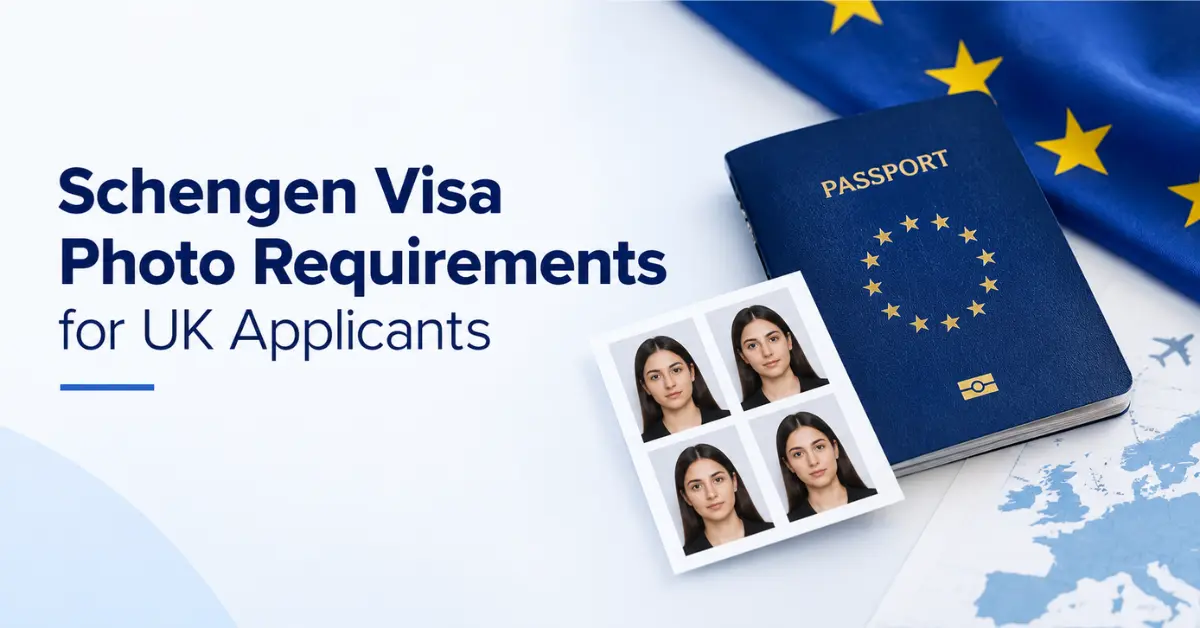
Photograph requirements are one of the more common reasons applications get delayed, so it’s worth getting right. Standard Schengen visa photograph requirements across consulates generally call for:
- A recent photo, usually taken within the past six months
- Standard dimensions of 35mm × 45mm
- A neutral expression with your face looking straight at the camera
- A plain, light-coloured background
- Head coverings are only allowed for religious reasons, with the full face visible
- Glasses are usually discouraged, and are not permitted if they cause glare or obscure the eyes at some consulates
Exact Schengen visa photograph size and formatting rules can vary slightly by consulate, so it’s worth checking your specific country’s current guidance, or having your photo taken by a professional photo service familiar with Schengen visa standards, rather than assuming an older set of dimensions still applies.
Which Documents Are Required for a Schengen Visa?
Requirements vary by country and travel purpose, but most UK applicants need a similar core set of documents:
- A fully completed and signed visa application form
- A valid passport with at least two blank pages and sufficient validity beyond your planned return date
- Recent passport-style photographs
- Evidence of UK residence or immigration status, where applicable
- A clear travel itinerary
- Proof of accommodation for your full stay
- Travel medical insurance meeting the Schengen minimum
- Bank statements showing sufficient funds
- Evidence of employment, business, or study
- Proof of ties to the UK (tenancy, mortgage, or family)
- Evidence of previous travel history, if any
- Any extra documents your consulate requests
Use this as a general guide, not a guaranteed outcome. At Euro Holidays, we help you confirm the exact list with your consulate before you apply.
Can You Get a Multiple-Entry Schengen Visa?
Yes, though it isn’t automatic. A multiple-entry visa lets you make more than one trip into the Schengen Area during its validity period. If you want the easiest Schengen visa option for frequent trips, this is usually the better choice once you qualify.
- Consulates usually give multiple-entry visas to applicants with a good track record travelling on the right dates, leaving on time, and not overstaying
- First-time applicants are more often given single- or double-entry visas
- Visa validity and the 90/180-day rule are separate. The rule allows stays of up to 90 days within any 180 days.
- A two-year multiple-entry visa doesn’t mean two years in the Schengen Area; the 90/180 limit still applies
Can I Get a Schengen Visa in 7 Days?
It’s possible in some cases, but you should not rely on a 7-day turnaround. A complete Schengen visa application is usually decided within 15 calendar days of submission. This does not include appointment waiting times or the time needed to return your passport.
A 7-day decision may be possible if the consulate has quick processing times, your application is complete, and no additional checks are required. However, this cannot be guaranteed. If your travel date is approaching, apply as early as possible rather than relying on a fast decision.
Which Schengen Country Is Easiest for a Tourist Visa?
There’s no officially easiest country for a tourist visa. What really matters is a realistic itinerary, enough funds, solid accommodation proof, and a clear intent to return to the UK.
Your main destination determines where you should apply, rather than a country’s refusal rate. For example:
- Say most of your trip is in Italy, with a short side trip to Slovenia
- You’d still apply through Italy, not the country with the better refusal rate on paper
Which Is the Hardest Schengen Country to Get a Visa?
Based on the most recent European Commission figures, a handful of countries have consistently posted the highest Schengen refusal rates:
- Malta — recorded the highest refusal rate of any Schengen state
- Estonia — notably higher-than-average refusal rate
- Belgium — notably higher-than-average refusal rate
- Slovenia — notably higher-than-average refusal rate
- Sweden — notably higher-than-average refusal rate
It’s best not to consider any of these countries as permanently the most difficult to get a visa for. Refusal rates are heavily shaped by the applicant profile a consulate typically handles, not just how strict its standards are. Rankings have also shifted considerably between years, so today’s higher-refusal country may not hold that position going forward.
How to Improve Your Chances of a Successful Schengen Visa Application
None of the following guarantees approval, but each addresses one of the most common, avoidable reasons applications get refused:
- Apply through the correct Schengen country for your main destination
- Complete every section of the application form accurately and fully
- Keep the information across your form and supporting documents consistent
- Show clear proof that you have enough funds for your trip.
- Provide a realistic and well-organised travel itinerary.
- Include valid accommodation evidence for every night of your stay
- Take out travel insurance that meets the Schengen minimum coverage requirement
- Demonstrate your UK residence or immigration status clearly, where required
- Avoid large, unexplained transactions in your bank statements before applying
- Submit every document requested, in the format specified
- Check the specific consulate’s current requirements shortly before your appointment, rather than relying on older guidance
Why Choose Euro Holidays for Schengen Visa Assistance
Preparing a Schengen visa application properly takes time, and it’s easy to miss a document or submit something inconsistent without realising it until a refusal letter arrives. Euro Holidays supports UK-based applicants through every stage, including:
- Explaining exactly what your consulate expects for your nationality and destination
- Reviewing your supporting documents before submission
- Helping you put together a clear, realistic itinerary
- Guiding you on proof of funds, accommodation, and travel insurance
- Advising on your UK residence or immigration status documentation
- Preparing you for your visa appointment with confidence
We can’t influence a consular officer’s decision; no legitimate visa service can. What we can do is help you avoid avoidable mistakes. Get in touch with our Schengen visa consultants in London for a consultation.
What is the easiest Schengen visa to get?
There’s no officially “easiest” Schengen visa. Slovakia has shown lower refusal rates in recent EU data, but approval still depends on your nationality, documents, and circumstances, and you must apply through your actual main destination country.
Which is the hardest Schengen country to get a visa?
Recent Commission figures show Malta, Estonia, Belgium, Slovenia, and Sweden with higher-than-average refusal rates. These rankings shift from year to year, so no country should be treated as permanently the hardest.
Can I get a Schengen visa in 7 days?
It’s possible but not something to rely on. Standard processing can take up to 15 calendar days once your application is submitted, on top of appointment waiting time, so apply as early as possible.
Which Schengen country gives a tourist visa easily?
None guarantees easy approval. Tourist visa outcomes depend on your itinerary, financial evidence, and ties to the UK far more than which country you apply to, and you’re required to apply to your genuine main destination.
Do I need a Schengen visa if I already have a UK visa?
Yes. A UK visa only covers entry to the UK. It doesn’t grant access to the Schengen Area, which has its own separate application process.
How much does a Schengen visa cost from the UK?
The standard consulate fee is €90 for adults and €45 for children aged 6–11, with children under 6 exempt. UK applicants typically also pay a separate visa application centre service charge on top of this.
Can I apply for a multiple-entry Schengen visa the first time?
It’s possible but less common for first-time applicants. Consulates more often issue single- or double-entry visas initially, with multiple-entry visas becoming more likely once you’ve built a compliant Schengen travel history.