A rejected photo can slow down your whole application, and it is one of the easiest mistakes to avoid.
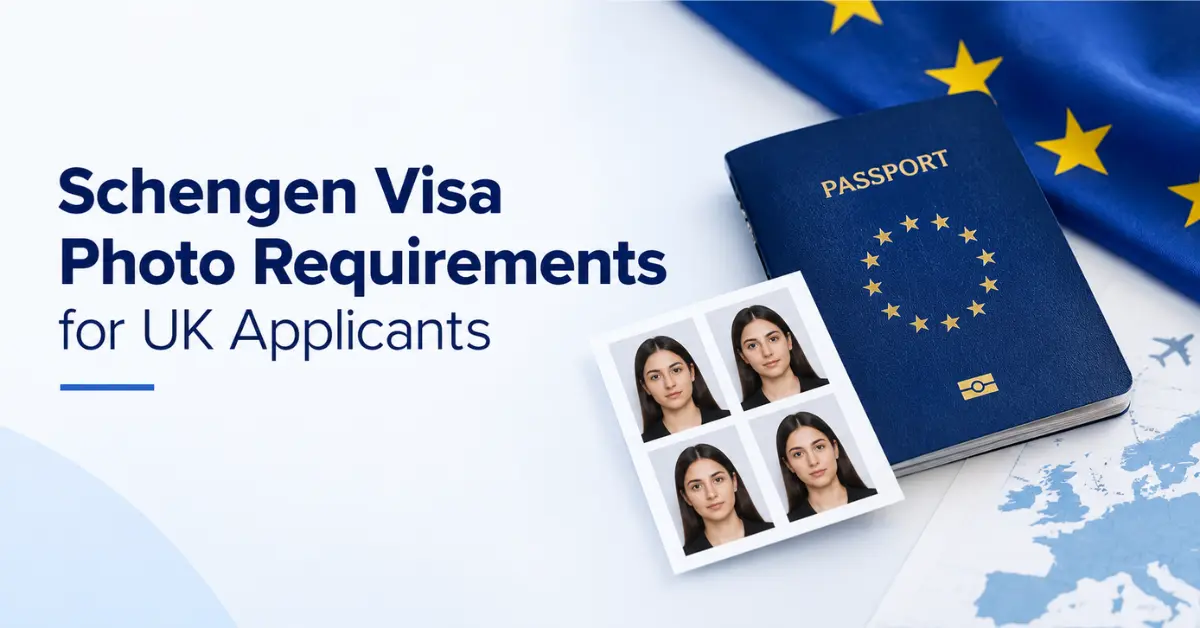
The short answer is simple. Your photo should be 35 x 45 mm, in colour, with a plain light background. It must be taken within the last six months, show a neutral expression, and your face should fill about 70 to 80 percent of the image.
Below, we explain the Schengen Visa Photo Requirements in plain English, including size, background, glasses, children, and where to get a photo in the UK.
What Is the Schengen Visa Photo Size?
The standard Schengen visa photo size is 35 mm wide and 45 mm high. That is 3.5 x 4.5 cm, or about 1.38 x 1.77 inches. These are the Schengen visa photo dimensions to use. If you are checking the photo size for Schengen visa applications, this is the measurement to remember.
Your head should fill roughly 70 to 80 percent of the picture, with your face and the top of your shoulders visible. A photo that is too zoomed in or too far away can be rejected, even if the overall picture size for Schengen visa applications is correct.
Photo Required for Schengen Visa: Key Specifications
Here are the Schengen visa photo specifications in one place:
- Size: 35 x 45 mm (3.5 x 4.5 cm)
- Colour: full colour, no black and white
- Age: taken within the last six months
- Background: plain, light and even, with no patterns or shadows
- Face size: about 70 to 80 percent of the image
- Expression: neutral, mouth closed, eyes open
- Quality: sharp, evenly lit, with natural skin tones
- Print: good quality photo paper, clean and free from creases
What Is a Biometric Passport Style Photo?
Most Schengen countries follow international photo standards set by the ICAO, and the Schengen visa passport photo requirements are built on the same rules. In simple words, a biometric photo shows your face clearly, looking straight at the camera, with even lighting.
This is why holiday snaps, filtered selfies, and cropped group photos do not work. Officials need a clear, natural image that matches how you look.
Schengen Visa Photo Background Colour and Image Quality
Your background should be plain, light and free from patterns. Sources differ on the best shade. Light grey is often suggested, and off-white is also common. Pure white can blend into light clothing or pale skin tones, so light grey or off-white is usually the safer choice unless your application centre says otherwise.
Lighting matters just as much. Avoid shadows on your face or behind your head, red eyes and glare. The photo should be sharp, in focus and true to your natural skin tone.
If you print your photo, use good quality photo paper. A resolution of 600 dpi is commonly recommended, although some sources mention 400 dpi as a minimum. Follow the instructions given by your application centre.
How Should You Look in a Schengen Visa Photo?
Look straight at the camera with a neutral expression. Keep your mouth closed and your eyes fully open. Do not smile, and do not tilt your head.
Your hair should not cover your eyes, eyebrows or the outline of your face. Your ears do not need to be visible. If you wear makeup, keep it natural so your face looks the same as it does in real life.
Choose a plain top that does not match the background. A darker colour usually works better against a light backdrop.
Can You Wear Glasses or Head Coverings in a Schengen Visa Photo?
If you can, remove your glasses for the photo. If you need to keep them on, your eyes and eyebrows must be fully visible, the lenses must be clear, and there must be no glare, reflections or shadows. Sunglasses and tinted lenses are not acceptable.
Hats and headwear that cast shadows or hide your face are usually not allowed. Head coverings worn for religious reasons are generally accepted, as long as your face is clearly visible from chin to forehead and the covering does not create shadows.
Schengen Visa Photo Requirements for Children and Babies
The same size and quality rules apply to children. The child should be the only person in the photo, so you cannot appear in the frame holding them. Toys and other objects should be out of the picture.
Children should look at the camera with a neutral expression as far as possible. For babies, many parents find it easier to lay them on a plain light coloured sheet and take the photo from above. Take several photos, because young children rarely stay still.
Printed or Digital Photo? How Many Photos Do You Need?
This depends on the consulate and application centre. Some ask for one or two printed photos. Others take the photo at your appointment or allow a digital upload. You will often see online advice saying two photos are always needed, but that is not true for every application.
Check the instructions for your specific application before you go. If you bring printed photos, a matte or glossy finish is generally fine as long as the print is clean, without creases, marks or ink stains. It is sensible to carry a spare set.
Where to Get a Schengen Visa Photo in the UK
- Photo booths: many UK booths offer passport photo sizes. Check that the booth is set to 35 x 45 mm and that the background looks plain and light.
- High street photo shops and larger pharmacies: staff can take and print the photo for you. Ask clearly for a Schengen visa size photo (35 x 45 mm).
- Post Office: some branches offer photo booths or passport photo services, so check your local branch first.
- Online photo tools: you can take a photo at home and get an edited digital file, then print it. Always compare the final result with the requirements yourself.
- Application centres: some centres offer photo facilities on site, usually for an extra fee. Confirm this before you rely on it.
UK Passport Photo vs Schengen Visa Photo
UK passport photos are also 35 x 45 mm, so many applicants wonder whether they can reuse one. The size often matches, but framing and background rules can differ slightly, and your Schengen photo must also be recent. You can read the UK rules on the GOV.UK passport photo page and compare them with the Schengen rules above.
Do not assume an old passport photo will pass. Photos in other formats, such as the 2 x 2 inch US size, will not fit either. When in doubt, take a fresh photo.
Common Photo Mistakes That Cause Rejection
Small photo errors are easy to miss. That is why many applicants ask the team at Euro Holidays to review them through our Document Checking Services before submission. Here are the mistakes we see most often:
- Wrong size, or a photo cropped too tightly or too loosely
- A photo older than six months
- Smiling, an open mouth or half closed eyes
- Shadows on the face or behind the head
- Patterned or dark backgrounds
- Glare on glasses, or tinted lenses
- Hair covering the eyes or eyebrows
- Filters, retouching or heavy editing
- Blurry or low quality prints
- Clothing that matches the background colour
- Creased or marked prints
Do Photo Rules Change by Schengen Country?
The main Schengen Visa Photo Requirements are shared across the Schengen Area, because they follow common standards. However, individual consulates and application centres can have their own instructions on how many copies to bring or how photos should be presented.
For examples of official guidance, see the French Ministry of Foreign Affairs sample photo sheet and the Dutch government photo rules. Always read the instructions for the country you are applying to. If you are also preparing your forms and supporting documents, our Application Support Services can help you keep everything organised in one place.
What You Still Need to Do Yourself
A photo check can reduce mistakes, but some steps must be completed by you:
- Choose or take a photo that reflects how you look today
- Do a final check of the size, background and print quality
- Attend your appointment in person
- Give your biometrics, such as fingerprints, when asked
- Sign your application yourself
Why Choose Euro Holidays?
We support UK applicants who want clear, organised Schengen visa paperwork. If you would like to talk through your situation first, you can also use our Visa Consultation Services.
- UK focused support for Schengen visa applicants
- Careful checks of photos and documents against current guidance
- Simple explanations without confusing jargon
- Help organising your documents before your appointment
- Honest advice, with no promises about visa decisions
FAQs
Is a white background okay for a Schengen visa photo?
The background should be plain and light. Some sources accept white, while others advise avoiding pure white because it can blend with light clothing. Light grey or off white is usually the safer choice. Check your application centre’s instructions.
Can I use my UK passport photo for a Schengen visa?
Only if it is recent, meets the size rules and follows the Schengen requirements. Because framing and background rules can differ, taking a new photo is often the safer option.
What is the size of a Schengen visa photo in cm and inches?
The size is 3.5 x 4.5 cm, which is 35 x 45 mm, or about 1.38 x 1.77 inches.
What happens if my photo is rejected?
You will usually need to provide a photo that meets the rules, which can delay your application or appointment. Checking your photo carefully beforehand helps you avoid this.